
Help plan the City of Canada Bay's future and steer decisions on issues that matter to you.
Share your feedback
Collaborate Canada Bay
Flooding
The NSW Government's Flood Prone Land Policy aims to improve the community's flood resilience by reducing the impacts of flooding on properties. Under the Policy, local government (i.e. Council) is responsible for managing flood liable land which involves the undertaking of Flood Studies to better understand the behaviour of flooding in an area. Flood studies help Council to:
- Ensure redevelopment is compatible with the flood hazard and does not create additional flood problems in existing developed areas.
- Identify potential strategies to reduce existing flood risk.
- Improve flood emergency response and recovery.
This page provides an overview of flooding within the context of the City of Canada Bay local government area, and answers some frequently asked questions about flooding.
Frequently Asked Questions
Search for a keyword.
What is flooding?
Flooding refers to the flow of water outside of its usual course. Flood water can flow across areas that are usually dry, including across roads and parks, or through properties. There are two types of flooding:
- Mainstream flooding: This describes how water in rivers and other watercourses builds up and overtops its banks, causing water to spread out over a floodplain. It typically occurs over a long period of time, and the water is usually deep and slow moving.
- Overland flooding: This describes how rainfall runoff flows across the surface of the land down towards the nearest watercourse. It typically occurs during or immediately after a storm event as rainfall runoff finds its way downstream. Overland flooding is often called flash-flooding due to the shorter warning times, and the water is typically fast and shallow. During overland flooding, the volume of rainfall runoff can exceed the capacity of the underground stormwater drainage system, and the excess water travels as overland flow downstream following the natural topography of the land.
In the City of Canada Bay, flooding is mainly overland in nature and is caused by heavy rainfall, although high tides and storm surges can contribute to worsening flooding conditions.
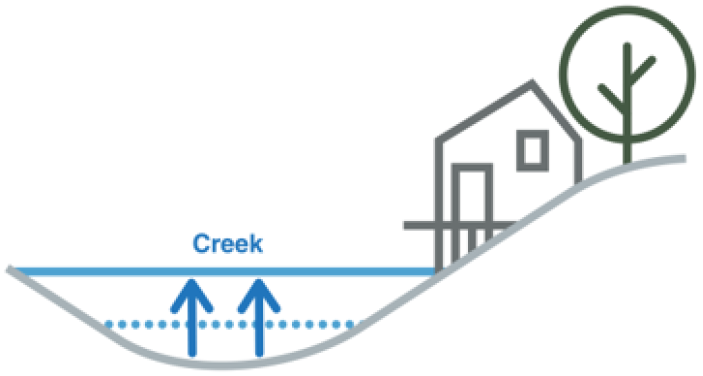 |  |
| Mainstream Flooding | Overland Flooding |
What is a flood study?
A flood study is a comprehensive technical investigation that aims to understand and determine the behaviour of flooding in an area. It utilises computer modelling to simulate the flow of water through a catchment during different intensity and different duration storm events.
A flood study includes the investigation and analysis of flood depths and levels, particularly at hotspot locations, flood hazard classifications, flood function categorisation, expected property inundation, estimated flood damages, and flood emergency response strategies, and it also explores potential flood mitigation measures that could help manage flooding in an area.
What does '1 in 100 year storm' and '1% AEP' mean?
'1 in 100 year storm' is the common name given to a storm event of a certain intensity. In this case, it refers to a storm event that has a 100 Year Average Recurrence Interval (ARI). Similarly, a '1 in 20 year storm' refers to a storm event that has a 20 Year ARI, and so on.
It is important to note however that this terminology is misleading because there is no guarantee that a 100 Year ARI storm will only occur once every 100 years. In reality, there is a chance that a 100 Year ARI storm can occur in two or more years in a row. Because of its misleading nature, ARI terminology has largely been replaced with the clearer AEP, or Annual Exceedance Probability terminology.
AEP means that in any given year, there is a certain chance that a storm of that intensity will occur. For example, the '1 in 100 year storm' equates to a 1% AEP storm, meaning that in a given year, there is a 1% chance that a storm of that intensity will occur. This is better terminology because it more clearly conveys that there is a chance that, for example, a 1% AEP storm event will occur multiple years in a row, even though the chance is very low.
See below a table that can assist in understanding the different terminologies for different storm events, and also that shows the chance of certain storm events occurring in a given time period.
| Common Name | ARI | AEP | Chance of Occurring in a 5 year period | Chance of Occurring in a 10 year period | Chance of Occurring in a 20 year period |
| 1 in 1,000 year storm | 1,000 Year ARI | 0.1% AEP | 0.50% | 1.00% | 1.98% |
| 1 in 100 year storm | 100 Year ARI | 1% AEP | 4.90% | 9.56% | 18.21% |
| 1 in 50 year storm | 50 Year ARI | 2% AEP | 9.61% | 18.29% | 33.24% |
| 1 in 20 year storm | 20 Year ARI | 5% AEP | 22.62% | 40.13% | 64.15% |
| 1 in 10 year storm | 10 Year ARI | 10% AEP | 40.95% | 65.13% | 87.84% |
| 1 in 5 year storm | 5 Year ARI | 20% AEP | 67.23% | 89.26% | 98.85% |
| 1 in 2 year storm | 2 Year ARI | 50% AEP | 96.88% | 99.90% | 100.00% |
What is flood planning area?
Flood planning area is the area that a flood study has identified as being below the flood planning level (ie. the height of the water plus a safety factor). It is a key planning tool for managing and mitigating flood risk in the City of Canada Bay.
Some properties have been identified as being flood planning area because some or all of the property is below the flood planning level. Properties that have been identified as flood planning area are subject to flood related development controls when developing or building on them.
What are flood related development controls?
When a development application is being prepared, flooding needs to be considered during the design of the development. Flood related development controls specify the special conditions and considerations that must be satisfied when developing or building on a property that has been identified as being flood planning area. This includes ensuring that the future development is sufficiently protected against any anticipated flood waters, and that the proposed development does not cause any negative flooding impact on nearby and downstream properties.
For further information on flood related development controls, please refer to the City of Canada Bay Development Control Plan, or consult with a suitably qualified engineer. For more information regarding the application of Council's flood related development controls and other engineering specifications, or if your engineer needs additional information, feel free to contact Council's Strategic Asset Services and Innovation Team on 9911 6555.
What is the 'PMF'?
The 'PMF', or Probable Maximum Flood, refers to the largest, most intense flood event that could conceivably occur at a particular location. The flood depths and levels calculated for the PMF event are primarily used to plan for emergency evacuation purposes, but are also used to assist the design of basement protections when a property is being developed.
What is a Section 10.7 Planning Certificate and what does it have to do with flooding?
Planning Certificates are legal documents issued by Council under the provisions of Section 10.7 of the Environmental Planning and Assessment Act 1979, that provide information on planning controls and any development restrictions which may apply to a particular parcel of land within the local government area. See Council's Section 10.7 Planning Certificate web page for more information.
Item 9 of a Section 10.7 Planning Certificate asks two flood-related questions:
1. Is the land or part of the land within the flood planning area and subject to flood related development controls?
2. Is the land or part of the land between the flood planning area and the probable maximum flood, and subject to flood related development controls?
These two questions outline the extent of flooding for the subject land. Note however that Council is only able to answer these questions if a flood study has been undertaken that includes the subject land. If a flood study has been undertaken that includes the subject land, then the responses to the questions on the certificate will either be ‘Yes’ or ‘No’.
If no flood study has been undertaken, then the response on the certificate will be ‘Unknown’. If this is the case, Council recommends that the applicant consult with a suitably qualified engineer who specialises in stormwater and flooding to verify whether the property or the proposed works in the subject property will be affected by, and/or have an impact on others during the 1% Annual Exceedance Probability (AEP) and the Probable Maximum Flood (PMF) storm events.
Does being flood planning area affect my property value and insurance premiums?
It is important to remember that the identification and determination of the flood planning area is an important step in managing flood risk, aiming to reduce risk to health and safety and reduce damage to properties. There are many properties across NSW that have been identified as being flood planning area for the purposes listed above.
The value of a property is determined by a range of factors including location, site conditions, adjoining developments, market conditions, interest rates, demand, etc. At present, there is no clear evidence that the adoption of the flood planning area would on its own result in a sustained impact on the value of a property.
Insurance premiums are determined by individual insurance companies based on their assessment of risk and probability, and are outside of Council’s control. Council recommends speaking to your insurance provider to get a better understanding of your insurance policy with regards to flooding.
What is Council doing to manage flooding?
In order to better understand the behaviour of flooding within the local government area, Council continues to undertake flood studies. One of the key documents to come out of a flood study is the Floodplain Risk Management Study and Plan (FRMS&P) which further analyses flooding risks and also explores possible actions and options to manage and mitigate the flooding.
In a developed, urbanised area such as the City of Canada Bay, the most effective flood risk management measure is the application of flood related development controls, and Council continues to apply these to new developments within the local government area. Another flood risk management measures includes emergency response planning, in which Council works with the NSW Government's State Emergency Service (SES) to analyse the flood data from a flood study and establish an emergency response plan.
Another important flood risk management measure that Council undertakes involves infrastructure projects to construct flood mitigation structures, such as levees, dams and detention basins, and to upgrade the stormwater drainage system. It is important to remember however that in dense, urbanised catchments, flood mitigation structures are not always possible to construct as they take up a lot of space and are costly.
Similarly, in our developed, urbanised catchment, upgrading the stormwater drainage system is not always a suitable option as stormwater drainage upgrade projects disrupt the community, are costly, and usually don't result in significant flood depth reductions given the sheer volume of water present in a flood event.
What can I do to prepare for a flood?
The NSW Government's State Emergency Service (SES) are the primary responders for floods in NSW. They have a great webpage that outlines how you can best prepare, respond and recover from a flood.
Where can I find more information?
More information on flooding can be found at the NSW Government Office of Environment and Heritage's Floodplains webpage. In here, you can also find the NSW Government's Flood Risk Management Manual, which explores managing flooding in more detail.
Flood studies
Flood studies that have been commissioned and adopted by the City of Canada Bay Council are:
- Parramatta Road Corridor Urban Transformation Study (PRCUTS), Stage 2 Flood Risk Assessment – Adopted in April 2024
- Powells Creek Flood Study – Adopted in December 2022
- Parramatta Road Corridor – Flood Risk Assessment for City of Canada Bay – Adopted in September 2020
- Exile Bay Catchment:
- Exile Bay Catchment Floodplain Risk Management Study & Plan – Adopted in August 2025
- Exile Bay Catchment Flood Study – Adopted in July 2020
Flood Studies that have been commissioned by the NSW Government and been accepted by Council:
- Rhodes East Priority Investigation Area Hydrology and Flooding Report – Completed in December 2016
Old studies that have been made redundant by newer studies:
- Concord West Precinct Master Plan Flood Study – Superseded by the Powells Creek Flood Study.
Flood studies that are currently being undertaken by the City of Canada Bay:
- Yaralla Bay and Rhodes Flood Study — Commenced 2026.
For more information on any of the above studies, please contact Council's Strategic Asset Services and Innovation Team on 9911 6555.
See below a map outlining the latest flood study that is applicable to a certain area. Note that where there is no flood study listed, Council has not yet adopted a flood study for that location.